



(William H. Waller – Endicott College, The Galactic Inquirer, and IAU/OAE/US-NAEC)
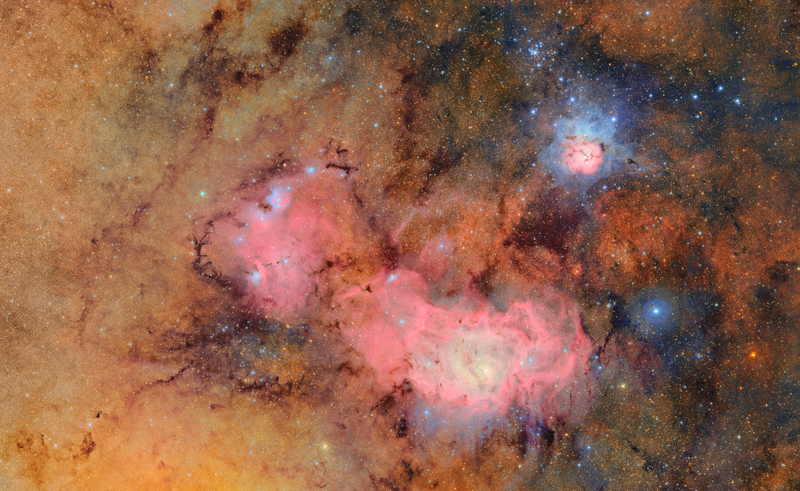
Fig. 1: The Lagoon and Trifid nebulae amid other regions of star-forming activity (Rubin Observatory)
It is not hyperbole to state that galactic ecosystems have spawned pretty much everything that we hold dear – including ourselves. These nebular nurseries have incubated all the stars, planetary systems, and many of the complex molecules known to humanity. From there, the myriad of planets in orbit around their hosting stars have further refined the organic matter into even more complex biochemicals. On the surface of one particularly moist planet, life took hold, and evolutionary processes led to you and me collectively pondering the wonders of galactic ecosystems as seen under dark skies and in vivid astronomical images. In this article, I introduce galactic ecosystems (GIs) of varying size and what they can tell us about our cosmic origins.
I begin by defining a galactic ecosystem as a complex of inter-relating stellar, nebular, and other matter that is actively forming new stars (cf. Fig. 1). Together, the components comprise a functioning environmental unit while responding to even larger environmental influences. Over its lifetime, such a complex is critically vulnerable to any newborn massive stars that it incubates.
Such fecund regions also play host to energetic stellar feedback which can lead to major transformations of the nebular structures along with new forms of nebular chemistries – up to and including biochemicals. For the sake of clarity, definitions of these respective terms follow.
Stellar Feedback: Ultraviolet radiation, powerful winds, and supernova blasts from newborn massive stars can transform the architecture of galactic ecosystems while transmuting their chemical makeup.
Biochemicals: The molecules that play key roles in sustaining life on Earth and perhaps elsewhere – e.g. H2O, H2CO, O2, CH4, HCN, NH3, PO4, amino acids, nucleotides, etc.
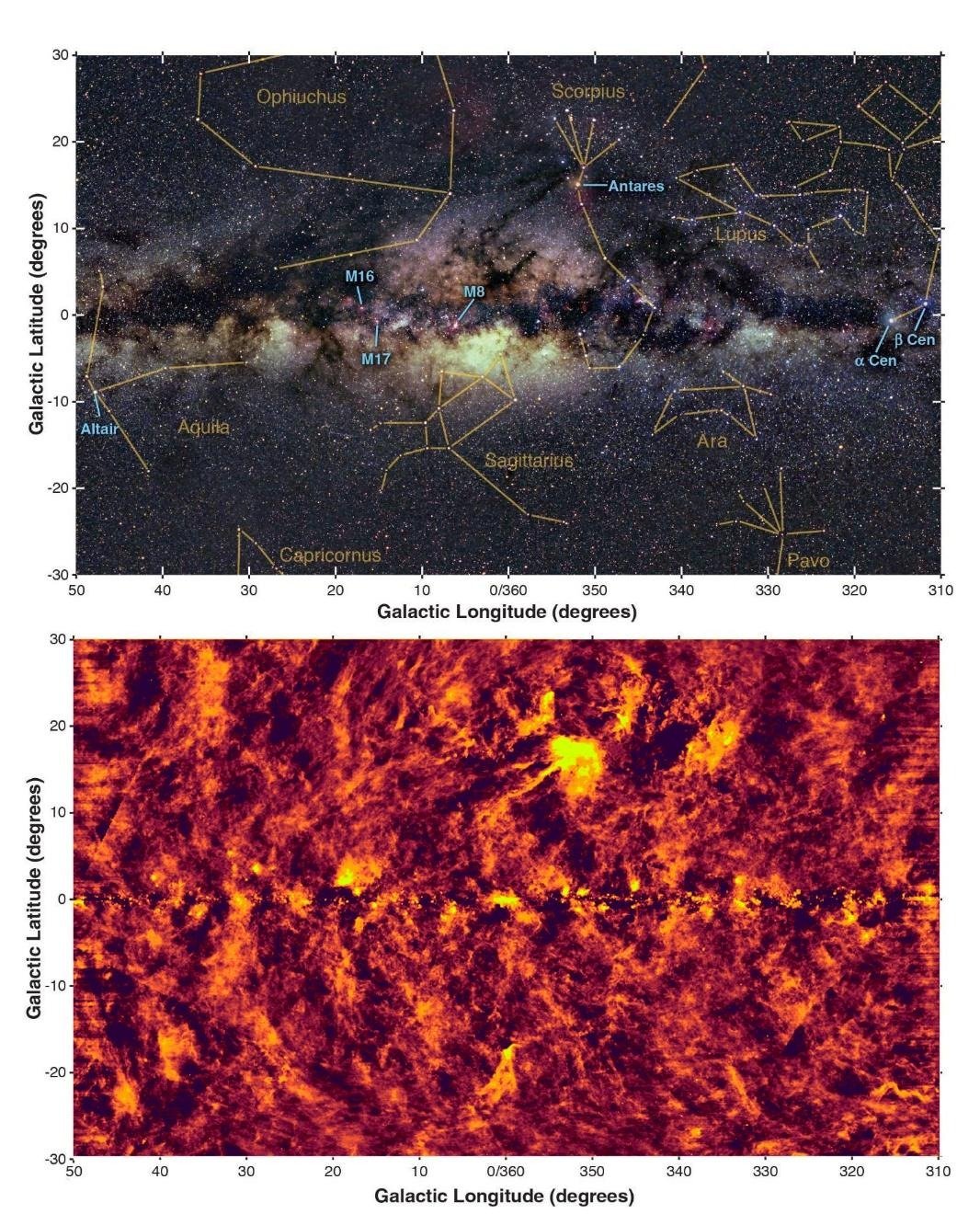
Fig. 2: Visible-light and far-infrared views towards the Galactic Center exemplify what can be delineated throughout the Milky Way in terms of obscuring dust and glowing nebulae at visible wavelengths (top) and glowing star-warmed dust clouds at far-infrared wavelengths (bottom).
I now show where galactic ecosystems can be found in our Milky Way galaxy. Through specially processed imaging at visible and far-infrared wavelengths, my colleagues and I have identified hundreds of these nebular nurseries populating the Galaxy (see Fig. 2). At visible wavelengths, dark clouds of obscuring dust can be seen in silhouette against the background starlight. These dark nebulae delineate the nearest and least massive galactic ecosystems, within which protostars and protoplanetary systems are incubating. The visible views also reveal roseate regions of ionized gas, whose fluorescent glow betrays the presence of hot massive stars having spawned among their lower-mass siblings. And what a difference a massive star can make – from photo-dissociating and photo-ionizing its once molecular birth cloud to exploding as a powerful supernova. These sundry transformations can lead to the production of new elements and complex organic molecules within the hosting galactic ecosystem.
At far-infrared wavelengths, star-warmed dust and hydrocarbon molecules within GIs glow prominently. We can see that the resulting “froth” of far-infrared emission delineates filaments and shells suggestive of cavitating activity from prior episodes of massive star formation. The galactic “gardening” that is evident in these images evokes a complex history of being and becoming.
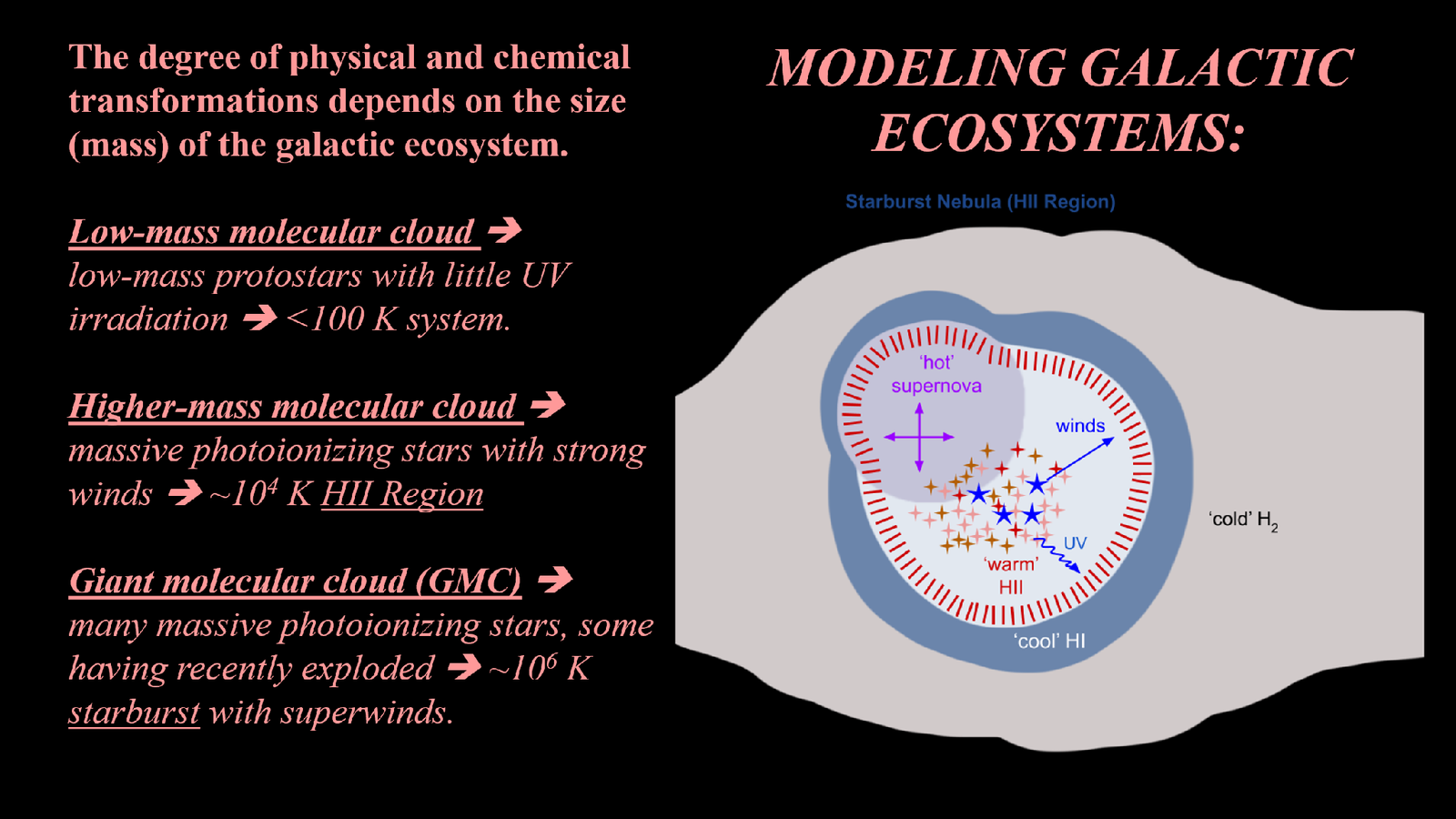
Fig. 3: Schematic model of a galactic ecosystem, where the mix of molecular, ionic, and coronal matter depends on the stellar population therein and hence the mass of the natal cloud.
Modeling galactic ecosystems presents many challenges, as these transient systems can drastically change over time. The masses of GIs also make a difference, with the least massive systems hosting protostars whose strong winds can literally shred their natal wombs into tangles of filaments. The more massive GIs have these protostars in abundance as well as rare massive stars, whose extreme ultraviolet radiation, powerful winds, and ultimate explosive deaths can completely annihilate their birth clouds (see Fig. 3).
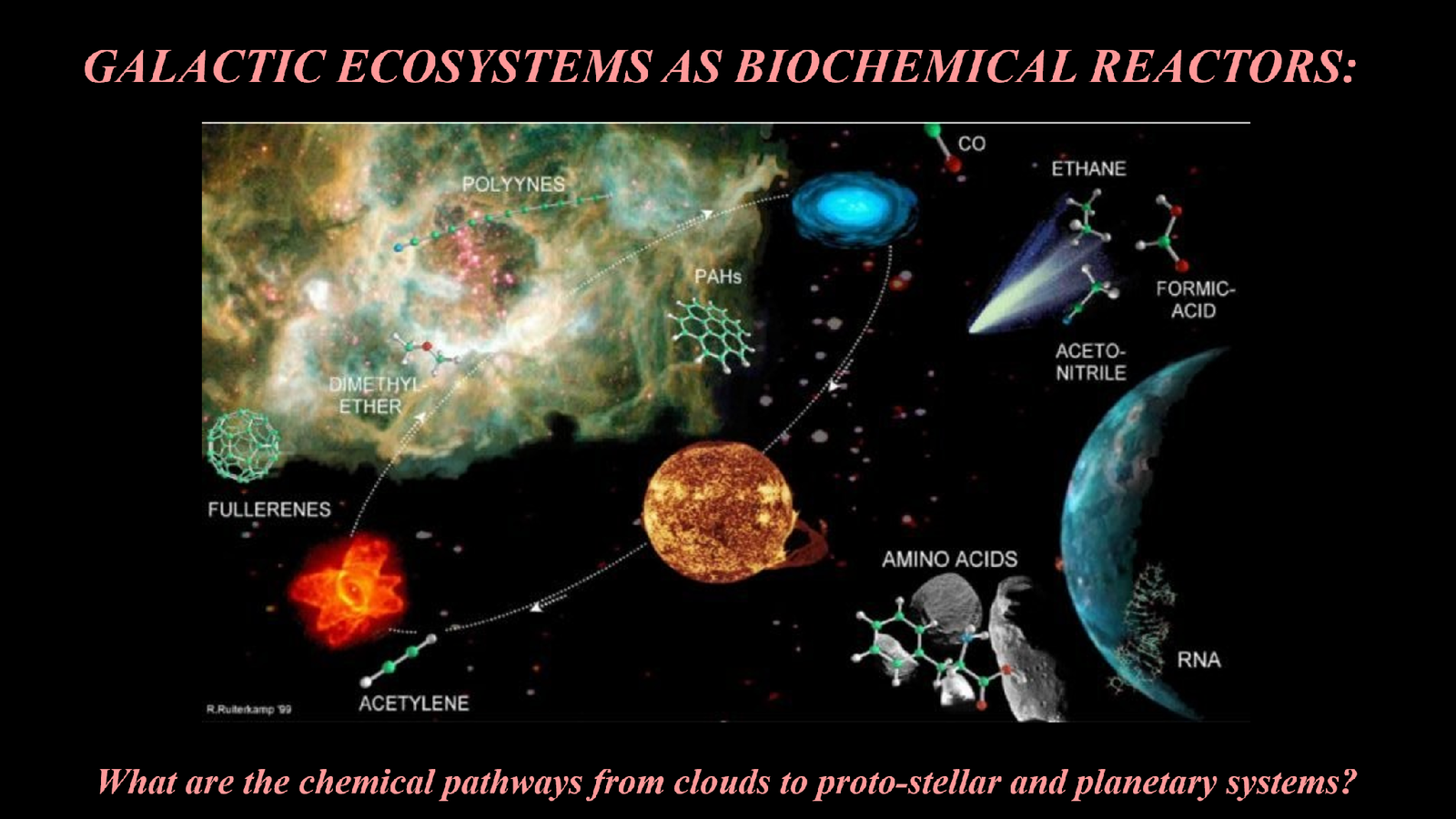
Fig. 4: The matter associated with galactic ecosystems evolves from the initial star-forming cloud (top left) to the protoplanetary system (top middle), main-sequence star (middle), and end-state planetary nebula that contributes dust and molecules back to the interstellar medium (bottom left). Along the way, a young planet receives biogenic molecules from infalling comets and meteorites (bottom right). On the planet’s surface, macromolecules such as RNA take form. (From of R. Ruiterkamp, — P. Ehrenfreund and S. Charnley 2000, ARAA, with permission)
Despite (and perhaps because) of all this tumult, these “crucibles of creation” serve as biochemical reactors, where complex organic compounds have been found in abundance. The chemical pathways for building the macromolecules familiar to us on Earth have yet to be delineated. However, the root stock is definitely there – churning within the galactic ecosystems and their protoplanetary progeny (see Fig. 4).
A new book on galactic ecosystems has been published by Springer-Nature as part of its Astronomers’ Universe series. Entitled Crucibles of Creation: Exploring the Origins of Stars, Planets, and Life within Galactic Ecosystems, this book engages readers on a guided tour of galactic ecosystems within the Milky Way galaxy and other nearby galaxies — including those in the throes of rampant starburst activity (see Fig. 5). Illustrated in full color, this book provides a definitive survey of galactic ecosystems and their evolutionary impact. Besides appealing to amateur and armchair astronomers, Crucibles of Creation … can be used as a primary resource for astronomy teachers and their students (https://link.springer.com/book/10.1007/978-3-032-17258-7). For further information, please contact the author at williamhwaller@gmail.com.
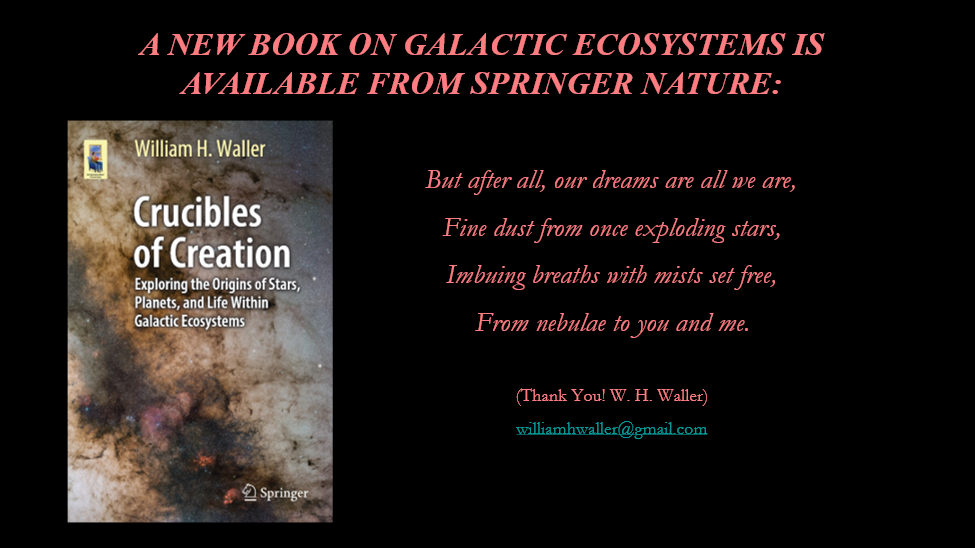
Fig. 5: Cover of book and summative poem on galactic ecosystems.
References:
Waller, W. H. “Exploring Galactic Ecosystems – The Transformative Wellsprings of Stars, Planets, and Life,” in Proceedings for the 7th Shaw-IAU Workshop on Astronomy for Education, 18-21 November (2025) p. 304. https://zenodo.org/records/19111022.
Waller, W. H. Crucibles of Creation: Exploring the Origins of Stars, Planets, and Life within Galactic Ecosystems, NYC, NY: Springer Nature (2025) https://link.springer.com/book/10.1007/978-3-032-17258-7.
A shorter version of this article was published as part of the Proceedings for the 7th Shaw-IAU Workshop on Astronomy for Education which occurred in November 2025.