



(Dr. William H. Waller – Endicott College and The Galactic Inquirer)
By now, you have probably read or heard that our polluting ways have reached a critical point, where Earth is rapidly approaching total failure as a planet. Perhaps you have wondered how we humans could have managed to do so much damage in so little time. Your bewilderment is well-deserved, as the planet itself is far from failing. It’s our relatively insubstantial biosphere that is in peril.
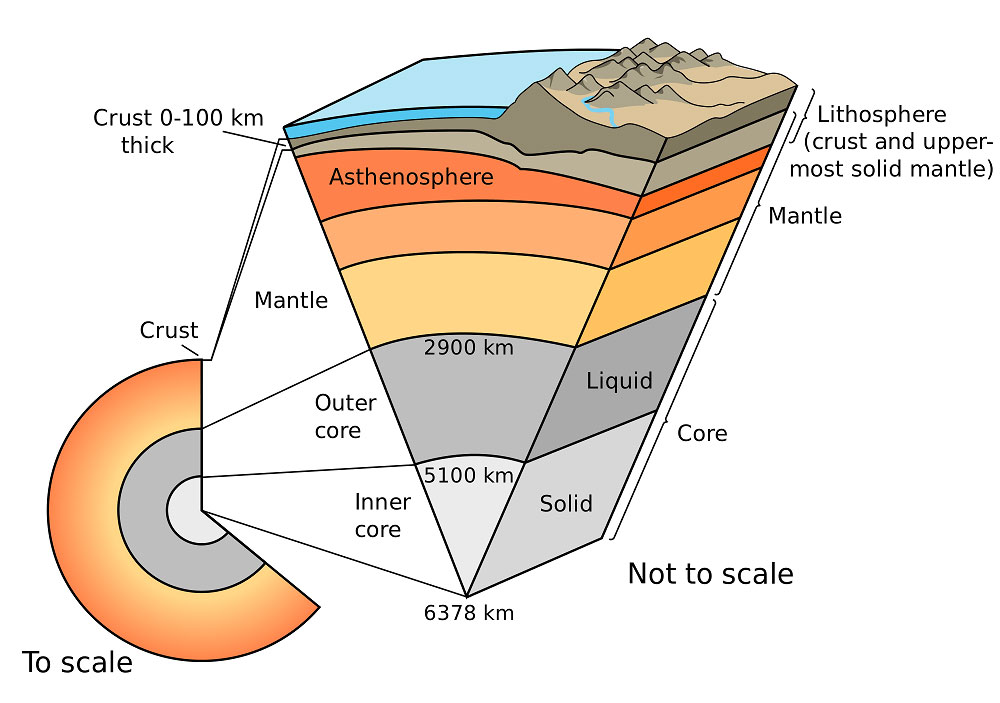
Cross sectional view of Earth illustrating its multiple layers. The ocean and mountain layers, along with the lower atmosphere, comprise the biosphere. In this diagram, they have been magnified tenfold for greater visibility. (Credit: U.S. Geological Survey)
Consider that Earth consists mostly of rock, and that the vast majority of this rock is well beyond our direct sensing, let alone our ability to alter in any way. From the dense nickel-iron core, through the pliable mantle, and outward to the stiff crust, all this rock spans a radius of 6,378 kilometers. By comparison, our biosphere has an estimated thickness of only 20 kilometers. From the tubeworms that inhabit the black smokers on the ocean floor to the bacteria in the upper troposphere that help to nucleate raindrops and snowflakes, this biological realm extends for only 0.3 percent of the Earth’s overall radius. If you could somehow walk vertically, you could traverse the biosphere in a workday with plenty of time for a nice lunch. By similar reasoning, if you took a grapefruit to represent the Earth and moistened it with a squirt gun, that thin glistening sheen would correspond to the entire biosphere. All that has ever lived on Earth has occupied this insubstantial scrim.
By changing our focus from the planet overall to the biosphere, we can better understand how human activities could have produced such consequential environmental effects in such short order. One key example is the chemical pollution from burning fossil fuels. Since the beginnings of the Industrial Revolution in the 19th Century, our incendiary ways have caused the amount of carbon dioxide in the atmosphere to increase by more than 50 percent. You might expect that such a major augmentation would leave a mark, and you would be correct. Like methane, nitrous oxide and water vapor, carbon dioxide absorbs heat radiation from the Earth’s sunlit surface and so serves as a greenhouse gas. Together with the increasing concentrations of these other greenhouse gases, the enhanced carbon dioxide levels are driving excess global warming and consequent climate changes.
Another important example of human activity degrading our biosphere is the cavalier attitude that we have maintained toward the various natural resources that ultimately sustain us. These vital resources include the fresh water, wetlands, forests, and wildlife that are threatened by our sundry land grabs and indiscriminate use of harmful chemicals for agricultural and industrial purposes. Once again, this degradation has increased dramatically with our increase in population, technological enterprise, and corresponding impact on the biosphere. By shifting our focus away from the fool’s errand of saving the planet and towards saving our living environment, we can be more effective as stewards of this same environment.
This change in focus from the entire planet to the biosphere can also encourage us to take action as dependent denizens of the biosphere. The to-do list becomes far more manageable. We can reverse our polluting practices and replace them with cleaner modes for generating useable energy, manufacturing useful products, and transporting these products and ourselves hither and yon. Regarding the planet itself, we can monitor and divert any itinerant asteroids that have Earth in their sights. But it’s the biosphere that really needs our help. We have sullied it as never before. Surely, we can clean up the mess that we have made.
Wonderful article, simply and succinctly describing the thin, precious band of atmosphere which keeps us alive and we have placed in peril. With that thought in mind, I’d like to thank you once again for introducing me to Dan Barstow of ASE and Earth Music Theater. Pasted below you’ll find a link to our collaborative work, Sanctuary Earth, with images of east Africa by ISS astronaut Jeanette Epps. Sanctuary Earth now forms the finale of my new cycle, *Home Planet*, a series of virtual orchestra pieces in praise of our beautiful but vulnerable planet with titles like The Overview Effect, In Orbit Around the Sun, Old Oaks Tell Tales; and in its defense, When Fires Turn the Sky Red. Home Planet will be released this spring on CD and streaming services, and I hope you’ll find the EMT video Sanctuary Earth a modest complement to your article. All the best!